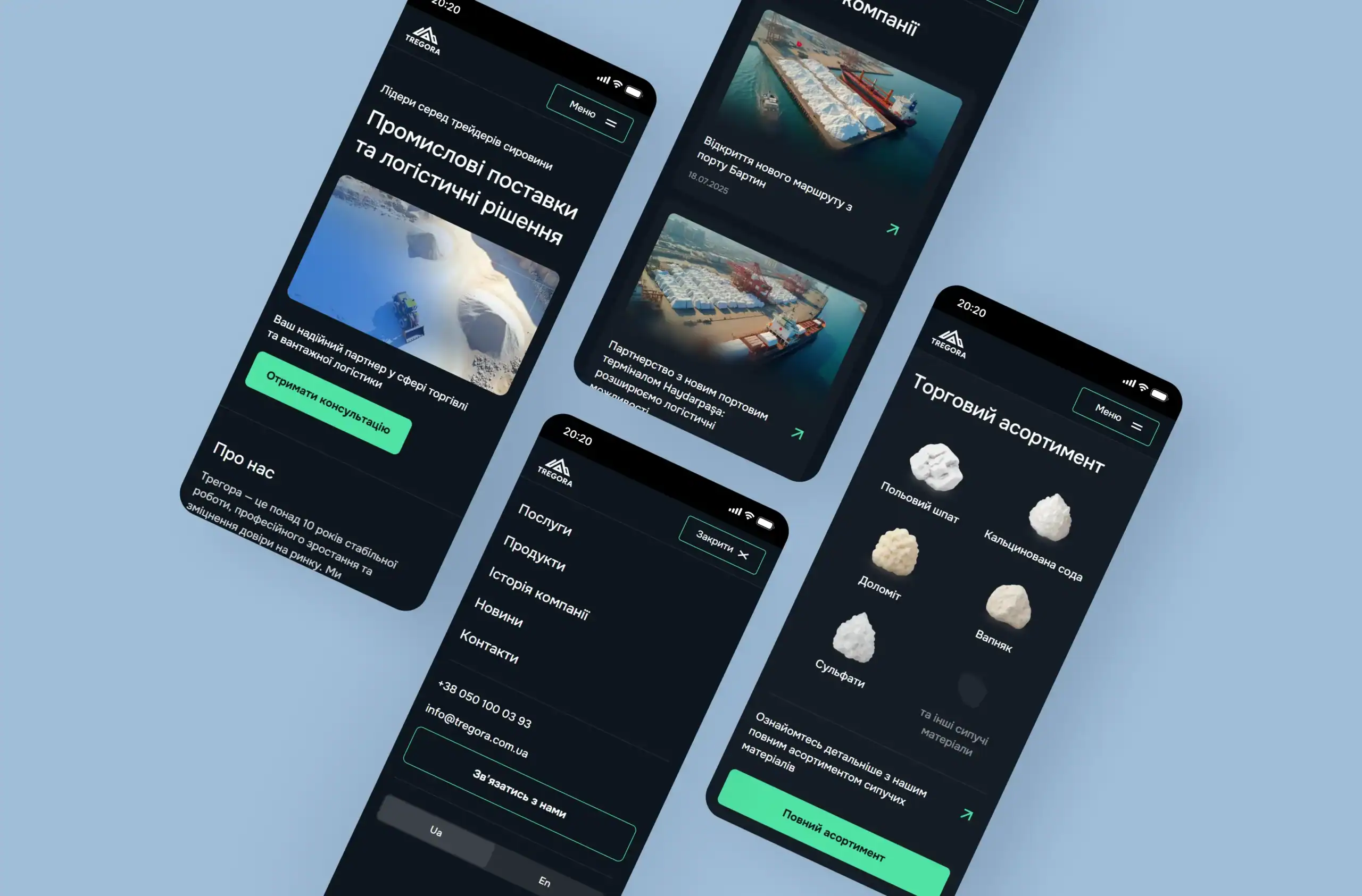
- 2025
- Corporate website
Tregora is a leader in the field of raw materials trading and logistics
22.11.2025
7 min

Choosing the right type of website for your business is not an easy task. There are a lot of blockers, including the client’s misunderstanding of what exactly they want to see on the site, what types of services they want to provide, and what integrations they need.
To do this, you need to analyse every little detail so that the client has a beautiful and functional website, and the studio doesn’t have to remake it several times.
In this article, you’ll learn how to clearly define the website your client needs.
In general, the types of websites can be ranked depending on the client’s needs. On the one hand, you may only need a landing page, and on the other hand, you may need a multi-page website with a lot of functionality and integrations, in several languages. Among the most popular are:
It is not always easy to choose the right solution, as the specifics of the business may require additional functionality, different pages, while the subjective vision of the business may also be a hindrance. That is why it is worth optimising the process of defining a website.
In addition, it is necessary to have a clear understanding of how the client will use the website after it is created. The choice of the platform on which the site will be created should depend on the client’s skills and wishes, so that they can make certain changes without disrupting the site’s operation.

A brief is an opportunity to clearly understand what the client wants. It should clarify exactly what the client wants to see on the website, what elements are needed there, and what design solutions are required. The brief should contain:
However, it should be understood that not every client knows what they want right away. The case when a customer just wants a website without any clarifications, and then makes changes to each idea is a sad classic. In this case, you should ask the client to show you what kind of websites they like and what they want to see on theirs.
It is not always the case that a client comes to you with a clear desire to create a landing page, an online store, and a vision.
After analysing the information, the specialist can also share their vision, send relevant examples, which can help to encourage the client to form their vision.

Communication with the client must proceed at all stages. Ideally, using the website builder, you can give access to editing and previewing so that the client can clearly see all the changes.
But every change and every new block should be shown to the client. On the one hand, this may take more time, but on the other hand, it will save time afterwards. You won’t have to reinvent the website and edit it completely if the client tells you what they don’t like right away.
In addition, you should think about the following communication options:
The client should also be informed about delays. If you can’t implement a certain element, you need to discuss it in advance.

One of the ways to successfully interact and quickly determine the type of website is to show what the client can get. To do this, you don’t need to create a lot of different types of websites from a scratch and show them to customers. On the contrary, it can be done quite easily.
Using website templates, a designer can slightly adapt it to the client’s vision, develop several such sites and fill them with stock images and AI-generated text, and that’s it. The client will choose which type of website he or she prefers, which fully corresponds to his or her vision.
After discussing and defining the best template, you can start working on it and develop it to turn it from a foundation into a ready-made and functional website.
You also need to clearly understand what integrations the client needs. Analytics, contact forms, payment and delivery methods. This not only determines the type of website, but also gives a clear understanding for the development of the user journey.
Any ‘extras’ should be discussed immediately, because later the client may simply wonder why their online store does not have the functionality they wanted but did not specify.
Website development is a complex and sometimes exhausting process. The type of website and the quality of its implementation directly depend on the mutual understanding between the developer and the customer.
The main thing is to keep a calm head, discuss certain details even several times, just to have a clear understanding of what the client wants. You should also not shy away from the idea of pushing the client to the right idea yourself, because someone may simply lack the references and understanding to get a complete picture of their future project.
Our thoughts on business, marketing,
design, and website development.
Available for new challenges


Fill out the form