- 2025
- Corporate website
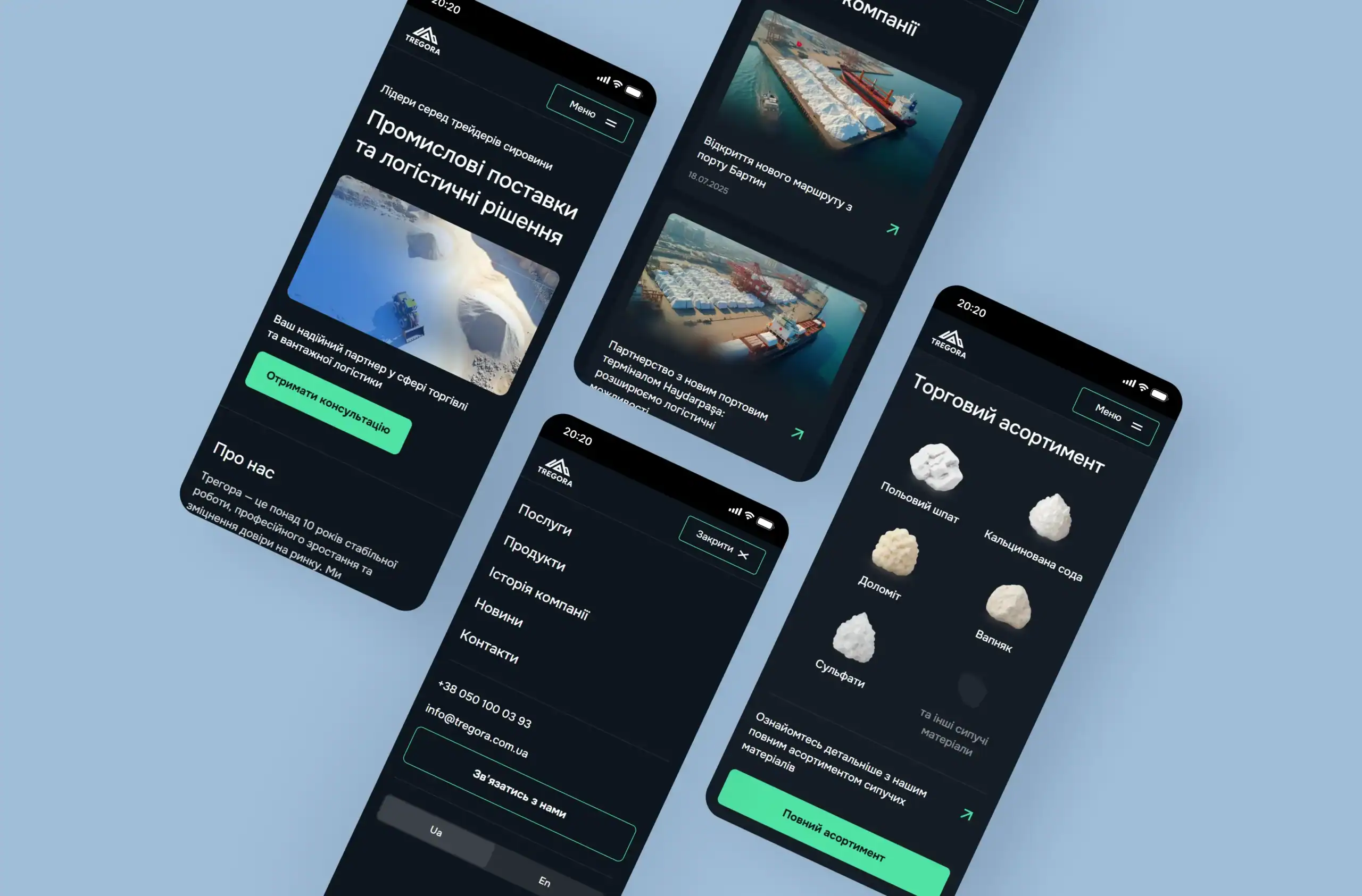
Tregora is a leader in the field of raw materials trading and logistics
17.06.2026

Professional restaurant website development is the creation of an automated lead-generation tool that converts visitors into regular guests. To guarantee profitability, the resource must include an optimized digital menu, a user-friendly online table reservation module, an in-house delivery ordering system, and seamless integration with POS systems and CRMs.
Most establishments begin their digital journey by using site builders or purchasing ready-made templates. Such a solution creates the illusion of a quick start but instantly becomes a bottleneck during the business scaling phase. Template architecture is always overloaded with universal code, critically reducing page load speed. Every additional second of user wait time proportionally decreases final conversions and the percentage of completed orders. Limited basic functionality prevents setting up deep end-to-end analytics or integrating complex loyalty programs.
In contrast, custom website development for a cafe or restaurant complex solves the fundamental problem of dependence on aggregators and third-party services. Custom development allows designing a unique sales funnel where the guest intuitively navigates the path from choosing a dish to confirming payment. The business owner gains full control over user data, behavioral analytics, and precise remarketing tools. A systematic approach to the digital product lowers customer acquisition cost (CAC) and steadily increases the company’s net profit.
The specialists at webCode.solutions work exclusively with custom WordPress-based solutions, fundamentally rejecting site builders and ready-made themes. This makes it possible to create an architecture where every interface element works toward achieving specific business goals.
Over 80% of traffic in the restaurant niche is generated by smartphone users. A hungry customer makes decisions impulsively and in a matter of seconds. If the establishment’s mobile version proves inconvenient, takes too long to load, or requires downloading a PDF document instead of an adaptive menu, the guest will close the page and go to competitors. A well-thought-out user experience (UX) is always built on understanding the situational context: a person on the go is looking for what to eat, how to get there quickly, and where to sit.
Modern restaurant website design must instantly fulfill these three needs without unnecessary actions. Navigation is designed with single-thumb interface control in mind. To ensure a high level of attention retention and stimulate sales, the mobile interface must contain a clear set of functional blocks:
Technical optimization of these mobile touchpoints directly reduces the bounce rate. A convenient user journey reliably converts a casual webpage visitor into a real guest with a high average check.
Delivery aggregators and third-party reservation platforms provide a quick flow of customers but consume a significant portion of your margin through high commissions. By creating your own food delivery website, you invest in an independent sales channel that quickly pays for itself and generates net profit. The commission for each order stays within the business, allowing you to reinvest funds into marketing or improving service quality.
Deep optimization of the sales funnel on your own platform enables effective management of the average order value through cross-selling. When a guest adds a main dish to their cart, the system automatically suggests relevant drinks, sauces, or desserts. On aggregators, you are forced to compete on price with dozens of other establishments on the same screen, whereas on your own website, the customer’s attention is focused exclusively on your menu.
Direct online table reservations operate on the same principle of boosting profitability. An interactive floor plan, the option to select a specific window seat, and instant confirmation create a premium customer experience even before the physical visit. The business acquires direct customer contact information, enabling future direct engagement without intermediaries.
A modern restaurant website cannot exist in isolation from the establishment’s internal operational processes. Two-way integration with CRM and POS systems transforms the website into a full-fledged digital manager. Price changes, adding a seasonal menu, or placing an item on the out-of-stock list at the register instantly sync with the website. This eliminates reputational risks and customer dissatisfaction caused by a guest ordering a dish that is no longer available in the kitchen.
Automated lead generation and data collection build a solid foundation for systematically improving the retention rate. Every delivery order or table reservation creates or updates the customer’s profile in the CRM. In real time, marketers can view a specific visitor’s order history, visit frequency, average order value, and favorite items.
This digitized data forms the basis of a strategy to increase Customer Lifetime Value (LTV). Instead of broad and expensive advertising campaigns, the establishment launches targeted, personalized marketing. For example, the system automatically sends a promo code for a new set on Thursday evening to a guest who orders sushi every Friday. This level of business analytics is only possible through the professional development of a unified ecosystem.
The main mistake many establishments make is trying to sell exclusively food, whereas guests most often buy atmosphere, emotions, and status. If your physical restaurant features a signature interior, dimmed lighting, and premium service, yet your web resource looks like a standard message board, instant cognitive dissonance occurs. A custom restaurant website design should act as the digital twin of your establishment, flawlessly conveying its vibe even before a table is booked.
The specialists at webCode.solutions develop exclusively custom visual solutions, completely rejecting ready-made themes. We thoroughly analyze brand positioning, corporate colors, and the core needs of the target audience to create a unique UI/UX design. High-quality food photography, smooth and unobtrusive animations, and thoughtful typography form a single, cohesive image.
This approach allows you to organically stand out among local competitors and leave a lasting impression on the user. Strong digital branding builds trust, automatically justifying an above-average check. You are not just displaying a list of dishes; you are broadcasting your business values through every pixel of the screen.
Business owners sometimes view digital tools as an expense, even though a professional platform is an asset that generates direct profit. The decision to commission an establishment’s website from experts directly impacts the time-to-market metric—the time from the project’s launch to receiving the first real online orders. At the webCode.solutions web studio, creating a full-fledged corporate resource starts at $4,000 (from 160,000 UAH), with a minimum implementation timeframe of two months.
These figures cover architecture planning, unique design development, and writing clean code based on the WordPress CMS. Considering the savings on aggregator commissions and the growth of the average order value due to an optimized sales funnel, such an investment yields a predictable and high ROI. The business gets not just a digital “business card,” but a fully autonomous lead-generation tool.
Code written from scratch makes it easy to scale the platform in the future. As your business expands, opens new locations, or introduces complex loyalty programs, the website adapts to these changes without requiring a complete overhaul.
Effective restaurant website development requires a deep understanding not only of technical standards but also of the specific business processes within the HoReCa sector. Attempts to build a platform yourself using site builders invariably lead to the loss of targeted traffic, system failures during peak loads, and lost profits. Stable lead generation, seamless transactions, and a high-converting mobile interface require an exclusively comprehensive and professional approach.
The webCode.solutions team has proven expertise in creating fast, functional, and scalable web resources. We build a reliable digital architecture that works to grow your sales 24/7. This allows you to focus on the strategic management of your establishment, culinary quality, and improving service levels.
Submit a request to discuss your project and get a precise estimate for achieving your business goals.
The key elements of an effective resource are a responsive digital menu with up-to-date prices, an online table reservation module, and functionality for ordering delivery. Equally critical is integration with a POS system and CRM—invisible to the customer but essential for the business—for inventory synchronization and database collection.
Professional corporate website development at the webCode.solutions agency starts at $4,000 (from 160,000 UAH). The exact budget is calculated individually and depends on the complexity of integrating accounting systems, the inclusion of an in-house delivery module, and the volume of visual content.
Developing a full-fledged web resource with a custom UI/UX design and clean code based on WordPress takes a minimum of 2 months. This time is necessary for designing the conversion funnel, layout development, setting up the admin panel, and thoroughly testing payment modules.
Yes, custom development allows for deep synchronization of discounts, reward points, and promo codes between the website and your internal accounting system. Your guests will be able to use their accumulated points both when ordering delivery online and when paying in person at the establishment.
Our thoughts on business, marketing,
design, and website development.
Available for new challenges



Fill out the form