- 2025
- Corporate website
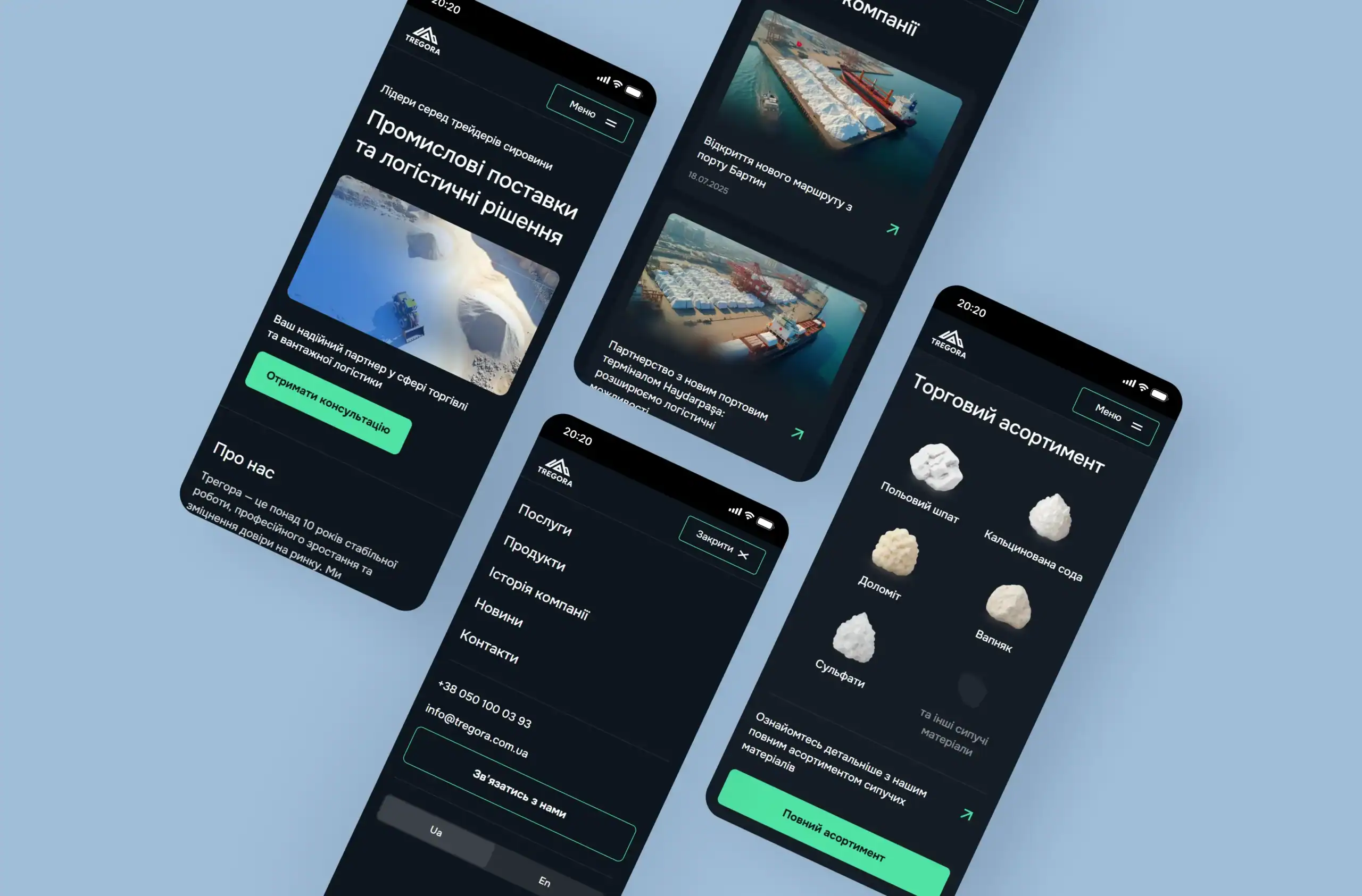
Tregora is a leader in the field of raw materials trading and logistics
14.05.2026

A technical specification for website development is a detailed document that describes the business goals, structure, functional requirements, and logic of user interaction with a web resource. A high-quality technical specification acts as an insurance policy for your investment, as it defines the scope of work, prevents unexpected costs, and ensures clear adherence to launch deadlines. Clear documentation allows the development team to focus on achieving high conversion rates and project ROI while avoiding technical mistakes and unnecessary iterations.
For a business owner, website development is primarily an investment that should generate profit. Without a detailed technical specification, any budget becomes vulnerable to hidden costs. When functional or design requirements exist only as verbal agreements, there is a risk of technical debt and endless revisions. Every code change made at later stages of development costs significantly more than planning it on paper in advance. A professionally prepared technical specification makes it possible to accurately estimate resources and direct them toward tools that directly impact ROI.
At webCode.solutions, we view documentation as a risk management tool. Our team specializes in creating unique custom projects where every structural element is aligned with the client’s business goals. For example, during the development of the website for Tregora, clearly defined requirements made it possible to create a full-cycle platform that transformed the company’s image from a simple supplier into a comprehensive B2B partner. This proves that smart planning is the foundation for future business scalability.
Investment in preparing a technical specification pays off already at the cost estimation stage. When the developer sees specific requirements, they can provide a fixed price and timeline. This gives the client financial predictability. The absence of documentation usually forces studios to add an extra 30–50% to the estimate for “unforeseen risks,” which you will ultimately pay for out of your own pocket. A clear specification helps avoid overpaying for unnecessary functionality and keeps the focus on what generates leads.
At webCode.solutions, we view documentation as a risk management tool. Our team specializes in creating unique custom projects where every structural element is aligned with the client’s business goals. For example, during the development of the website for Tregora, clearly defined requirements made it possible to create a full-cycle platform that transformed the company’s image from a simple supplier into a comprehensive B2B partner. This proves that smart planning is the foundation for future business scalability.
Investment in preparing a technical specification pays off already at the cost estimation stage. When the developer sees specific requirements, they can provide a fixed price and timeline. This gives the client financial predictability. The absence of documentation usually forces studios to add an extra 30–50% to the estimate for “unforeseen risks,” which you will ultimately pay for out of your own pocket. A clear specification helps avoid overpaying for unnecessary functionality and keeps the focus on what generates leads.
Clients often confuse a brief with a technical specification, which leads to weeks being lost during the development stage. A brief is a questionnaire where you describe your wishes: “I want a website in blue colors that makes ordering convenient.” It is only the foundation that outlines the direction of the work. A technical specification, on the other hand, is an engineering instruction that tells the developer: “When button X is clicked, the client’s data must be instantly transferred to KeyCRM via API.” Separating these stages is critical for accelerating Time-to-Market.
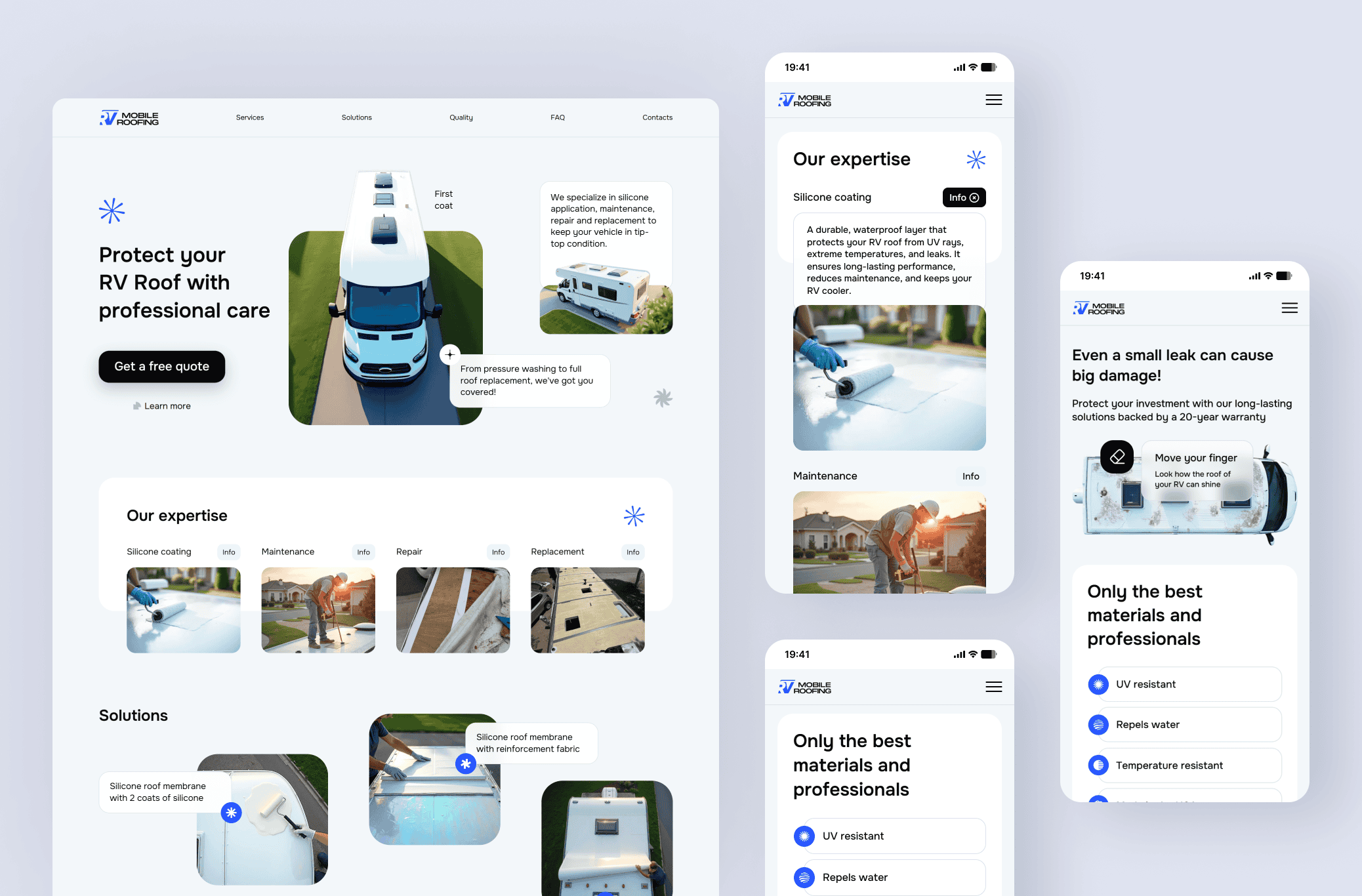
Time savings begin when developers receive answers to all questions before writing the first line of code. In our practice, the implementation of a corporate website usually takes from 2 months, while a landing page takes from 1 month. These timelines are modular and depend on how quickly we can approve the business requirements. For example, in the RV Mobile Roofing case for the US market, detailed development of the three-step application form made it possible to launch the website as quickly as possible and immediately direct advertising traffic to it.
The more detailed the interaction logic is, the less time is spent on testing and fixing bugs. When we work on a corporate website, we plan the structure, navigation, and interactive elements in advance. This allows the team to work in parallel: the designer creates layouts while the developer prepares the WordPress admin panel. This approach reduces the overall production time, allowing your business to start generating revenue from the new resource several weeks earlier.
A high-quality technical specification for website development translates the language of business into clear instructions for engineers. The process of creating this document always begins not with a discussion of design, but with an analysis of the target audience and its pain points. A precise understanding of who exactly buys your product determines the entire future architecture of the web resource. Based on this data, a sales funnel is formed — a well-thought-out user journey from the first page view to submitting contact details.
To ensure that the investment delivers results and supports high conversion rates, the document must include several essential sections. These include business requirements, a description of target segments, a detailed page structure (Sitemap), and requirements for interface logic. The behavior rules for interactive elements, animations, and lead capture forms must also be described in a separate section.
A well-planned page structure prevents situations where a potential client wanders around the website and cannot find the order button. Each screen must perform one specific function: hold attention and smoothly guide the visitor further through the funnel. When developing a landing page for Beauty International School, we focused specifically on this logic. All information about the training course was logically structured and visually separated, which ensured maximum return from the client’s advertising campaigns.
After describing the business logic, it is necessary to define the technological foundation of the resource. This section of the technical specification outlines the specific functionality: from basic contact forms to complex filtering systems or catalogs. For a business owner, it is critical to choose a technology stack that will not require excessive financial investment for basic website maintenance in the future. This is why we reasonably recommend implementation based on the WordPress CMS.
Throughout the existence of the webCode.solutions team, we have successfully delivered more than 200 projects, choosing this platform as our exclusive tool. The main advantage of this approach is the optimal balance between budget, launch speed, and client independence. Our custom development without the use of heavy template builders ensures clean code. This directly affects page loading speed and makes further search engine promotion easier. You do not overpay for developing a product from scratch on complex frameworks, yet you receive a fully unique solution.
For a company’s marketing department, a convenient, intuitive, and secure admin panel is extremely important. Managers should be able to independently publish articles, update price lists, or add new services without regularly involving developers. We create custom control panels adapted to the needs of each specific client, preventing accidental damage to the layout. This approach ensures long-term business scalability: over time, the website can be easily expanded with new functionality without rewriting the existing code.
A modern website does not exist in isolation — it is part of a business’s broader ecosystem. If a resource generates dozens of inquiries every day, but they get lost in email, the conversion rate into sales drops rapidly. That is why the technical specification must include requirements for integrations with third-party services. A clearly defined data transfer logic ensures that every inquiry is instantly delivered to managers in a convenient format, eliminating the need to transfer information manually.
The CRM system setup is often the main bottleneck. We always recommend including API synchronization requirements in the technical specification. For example, while working on the landing page for Beauty International School, we clearly defined the need to automatically collect inquiries directly into the client’s database. This KeyCRM integration completely eliminates the human factor: leads are not lost, and the sales department can start processing the request just a few seconds after the client clicks the button on the website.
In addition to contact management, the documentation must strictly define the connection of web analytics tools. The technical specification determines which specific user actions need to be tracked — form submissions, clicks on a phone number, or price list downloads. Properly configured analytics allows marketers to accurately calculate customer acquisition cost (CAC) and objectively assess the profitability of advertising campaigns.
Experience shows that investing time in preparing documentation always translates into a faster launch and the absence of rework. Our development case studies clearly demonstrate how a deep understanding of business objectives at the start can dramatically change the final result. Detailed planning helps clients receive an effective tool exactly on time, avoiding the classic problem of “endless revisions.”
When creating a project for Tregora, a B2B company specializing in international logistics and raw material supply, we thoroughly defined the architecture of the services page. As a result, the corporate website received a powerful lead generation tool with clear calls to action. The team planned unobtrusive feedback forms in advance, which minimized the time spent on pre-sale communication and provided the client with a stable flow of targeted leads.
Another example is a promotional landing page for the American company RV Mobile Roofing. In the technical specification, we defined an interactive engagement element and a clear three-step data collection form. This allowed the developers to immediately implement the correct logic, while the business was able to quickly scale its online promotion and improve business results.
For the national office of the European eTwinning programme, the critical factor was structuring large volumes of data. The technical specification included a precise description of how the filtering system, article tagging, and interactive map display logic should work. Clear requirements helped avoid confusion during database development. As a result, the complex architecture was deployed without a single missed deadline.
Even with significant investment, a project can exceed the planned budget due to inaccuracies in the documentation. The most common mistake is using vague wording such as “user-friendly interface” or “modern design.” Since these concepts are subjective, the developer may implement logic that does not match your expectations, leading to endless iterations of revisions. Each such iteration means additional hours of work for the team, which directly increases the development budget.
The second critical mistake is ignoring functional details. For example, the requirement to “create a product catalog” without describing the filtering and sorting system is incomplete. In the redesign case for A-Finance, we paid special attention to developing a car sales catalog with advanced filtering. If these parameters had not been defined in the technical specification, the client could have received a non-functional list of products that would not allow users to quickly find the right car, automatically reducing conversion.
The third trap is excessive functionality that does not provide business value at the start. Business owners often try to add complex features “for the future,” which creates hidden costs and delays the launch. A more rational approach is to develop a high-quality MVP (minimum viable product) and scale it after receiving the first results. If you are not sure whether certain features are necessary, we recommend ordering UX/UI services or a technical audit, with pricing starting from UAH 20,000. This makes it possible to objectively assess the requirements and eliminate unnecessary elements before coding begins.
The fourth mistake is the absence of clear requirements for the mobile version. Since most users visit websites from smartphones, responsiveness must be defined as a priority. In the project for the Optima32 dental clinic, we focused specifically on navigation convenience for mobile devices.
The fifth mistake is ignoring the content preparation stage. If the technical specification does not define who is responsible for content and which media formats will be used, the website launch may be delayed for weeks due to missing texts or images.
A high-quality technical specification for website development is not just a list of features, but a strategic document that aligns your commercial goals with the capabilities of technology. It ensures financial transparency, allowing you to receive an accurate estimate instead of vague numbers. With clear documentation, you are not buying hours of developers’ work, but a specific result: a tool that generates leads, strengthens your brand, and delivers a high ROI.
At webCode.solutions, we build cooperation on the principles of an individual approach and clean code. Using CMS WordPress as our core stack allows us to create flexible and fast solutions that are easy to manage without a technical background. Our statistics speak for themselves: more than 80% of clients come to us through recommendations. This is the result of the fact that we do not simply develop websites — we create assets that work for the business from the very first day after launch.
If you are planning to order a website, remember that professional development starts with a deep dive into your objectives. Clear planning allows us to implement projects of any complexity — from concise landing pages to multi-page corporate portals — while strictly adhering to deadlines and budget. Entrust the development of your technical strategy to experts so you can focus on growing your business while your website turns visitors into loyal customers.
An effective technical specification must include a description of the project’s business goals, a profile of the target audience, a detailed sitemap, and functional requirements for each element. The document should clearly define the interface logic and the conditions for integration with third-party services in order to ensure high conversion and avoid hidden costs.
The business owner provides the initial information and business requirements, while the final technical specification is prepared by a professional web studio. This ensures the selection of a rational technology stack, such as custom WordPress development, which makes it easy to scale the website in the future without accumulating technical debt.
A brief is a short questionnaire containing your preferences and goals, while a technical specification is a detailed engineering instruction that leaves no room for ambiguous interpretation. Having a technical specification allows the webCode.solutions team to provide a fixed estimate and timeline, protecting your budget from unexpected costs during development.
The technical specification defines in advance the mechanics of collecting inquiries and automatically transferring them to a CRM system, for example through API integration with KeyCRM. This eliminates the human factor, ensuring that no client is lost and that the sales department can respond to new requests instantly.
A proper technical specification is based on the results of an audit and competitor analysis, where each function is aligned with achieving a business result and return on investment (ROI). The document is considered high-quality if it allows developers to work in parallel on design and code, significantly reducing the overall Time-to-Market.
Our thoughts on business, marketing,
design, and website development.
Available for new challenges



Fill out the form