- 2026
- Corporate website
Perfect Group is a leading real estate development company in Ukraine

A website can cost anything from a $12-a-month site builder subscription to tens of thousands of dollars for custom development by an agency. A difference that large isn’t greed on one side and generosity on the other. The money buys different things: a ready-made template with your logo dropped in, or a site designed around your business.
Below: what the price is made of, what different levels of development cost, which expenses come after launch, and how to compare quotes so you neither overpay nor buy a cheap site you’ll have to rebuild.
| Level | What it costs | What you get |
| Site builder, do it yourself | A subscription: Squarespace from $12 a month, Wix from $17.77 a month, billed annually | Ready-made blocks you assemble yourself. The time is yours |
| Freelancer or agency using a template | Billed at far lower rates than custom work: Clutch lists website builder specialists at $25–49 an hour | An off-the-shelf theme with your colours, logo and copy swapped in |
| Agency with partial customisation | According to Clutch, most web design projects come in under $10,000, and agencies typically bill $100–149 an hour | A template as the base, with some pages built around you |
| Custom development | The average web design project on Clutch is about $38,000; large projects go well above $100,000. Our prices start at $2,000 for a landing page and $4,500 for a business website | Structure, design and code built for your business from scratch |
No level is “right” in itself. The question is what the site has to do for you and what happens if it doesn’t.
The price of a website is people’s working time. So it’s driven not by “the number of pages” but by the amount of work at each stage.
We’re a web studio from Ukraine and build websites on WordPress with custom design, no off-the-shelf themes. Starting prices:
| Website type | Price | Timeline | What it’s for |
| Landing page | from $2,000 | from 1.5 months | One page for one service or offer |
| Business website: Starter | from $2,500 | from 1.5 months | A small company site, up to 5 unique templates |
| Business website: Business | from $4,500 | from 2 months | A company with several lines of business, up to 15 unique templates |
| Catalogue | from $4,500 | from 2 months | Showing your range without a cart or checkout |
| Online store | from $4,500 | from 2 months | Selling online: cart, payment, shipping |
The price of a business website includes custom design, responsive front-end, a configured admin panel with a video guide, speed optimisation, basic SEO setup and a one-year warranty on our work. The price goes up for the same things listed above: integrations, languages, a complex catalogue, custom features.
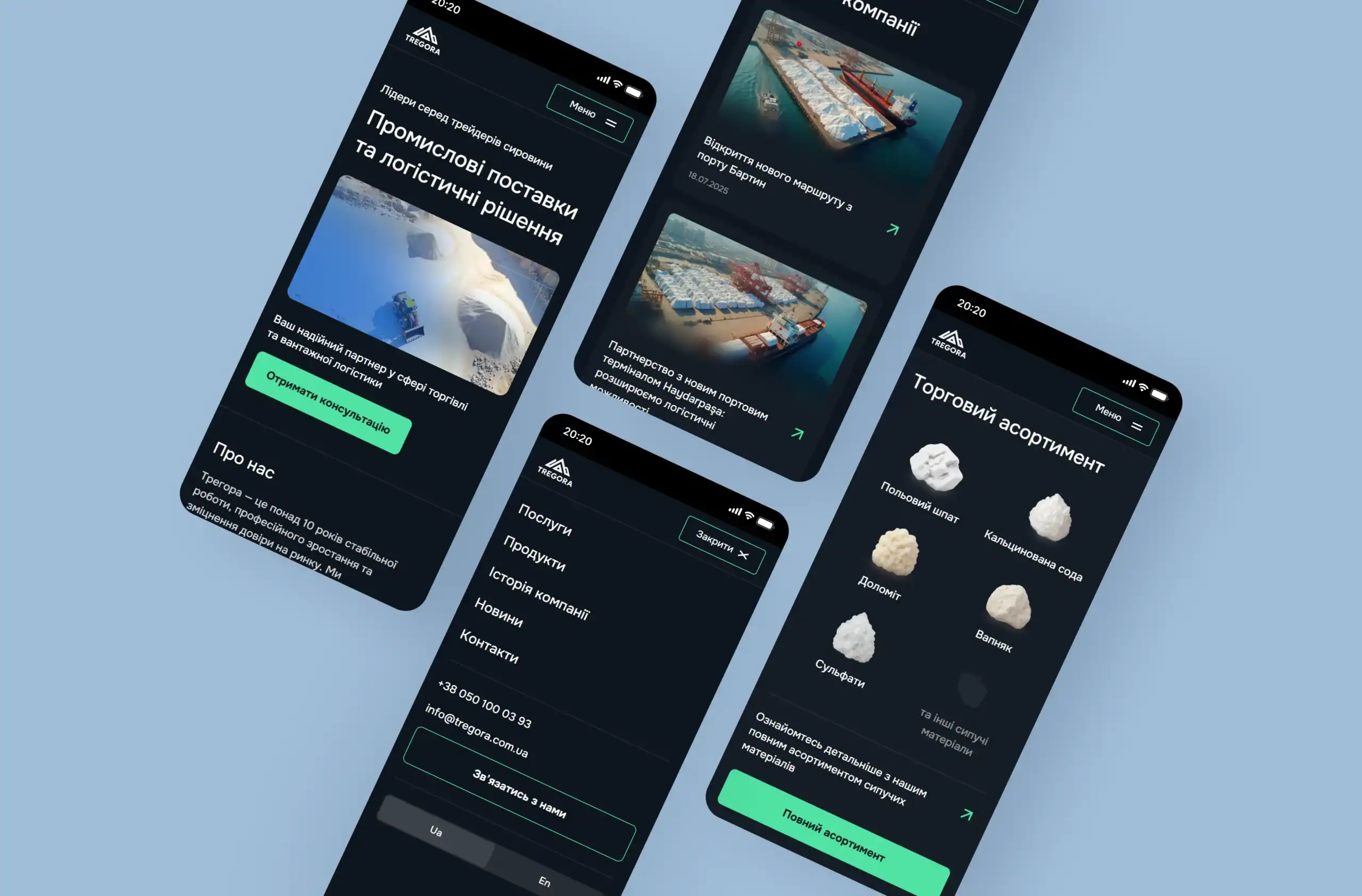
We cost more than a template build and less than a typical US or Western European agency, because our team is in Ukraine. You can see what that money gets in our case studies, for example the Tregora website redesign with an admin panel where the client’s team updates the product range and news themselves.
The development invoice isn’t the last one. Budget for:
Make sure the domain and hosting are registered in your name and that all access is handed over after launch. It’s the most common problem with cheap contractors: the site is formally yours, but only the contractor can manage it.
A cheap website isn’t cheap because the contractor found a secret. It saves on the same stages the price is made of.
A ready-made theme instead of design. A universal theme carries code for hundreds of features you don’t need. Pages get heavier and load more slowly, especially on phones. What that means for enquiries is covered in our article on website loading speed.
Plugins instead of development. Every feature is covered by a separate plugin. A year later there are dozens of them: they conflict after updates, and each one is another potential security hole.
No structure to grow into. While the site is small, you don’t notice. When a new line of business or a catalogue comes along, it turns out there’s nowhere to add it, and the site has to be rebuilt almost from scratch. You pay twice: first for a quick launch, then for a full rebuild.
Changes after launch cost extra. A low starting price is often made up for by paid edits, and without an admin panel there will be plenty of them.
A list of the typical expensive mistakes worth checking before you start is in our article on website development mistakes.
Not every business needs custom development. A site builder or an inexpensive template is a perfectly good solution if:
Custom development pays off where the website does real work: you run ads to it, companies send enquiries through it, and prospects judge you as a supplier by it. A comparison of platforms is in our article on choosing a CMS.
Two offers, “a website for $3,000” and “a website for $15,000”, can mean completely different things. To compare them fairly, ask each contractor:
More questions for a contractor are in our article on how to choose a web agency.
An exact price can only be given once it’s clear what exactly is being built. The quickest way is to describe the task: who your customers are, what they should do on the site, which sections and features you need, which systems it must integrate with. You don’t have to write a full specification; answers to these questions are enough. If you want to prepare thoroughly, use our guide on how to write a website specification.
With such a description, a realistic price and timeline range can be named in the first conversation, and an exact estimate once the site structure is agreed.
Our thoughts on business, marketing,
design, and website development.
Available for new challenges



Fill out the form